Navigating AI's Economic Shift: Who's Really Profiting from the AI Boom?
Trillion-dollar valuations, violent swings, one quiet question underneath: when the gold rush finally pays out, whose pocket does the money land in?
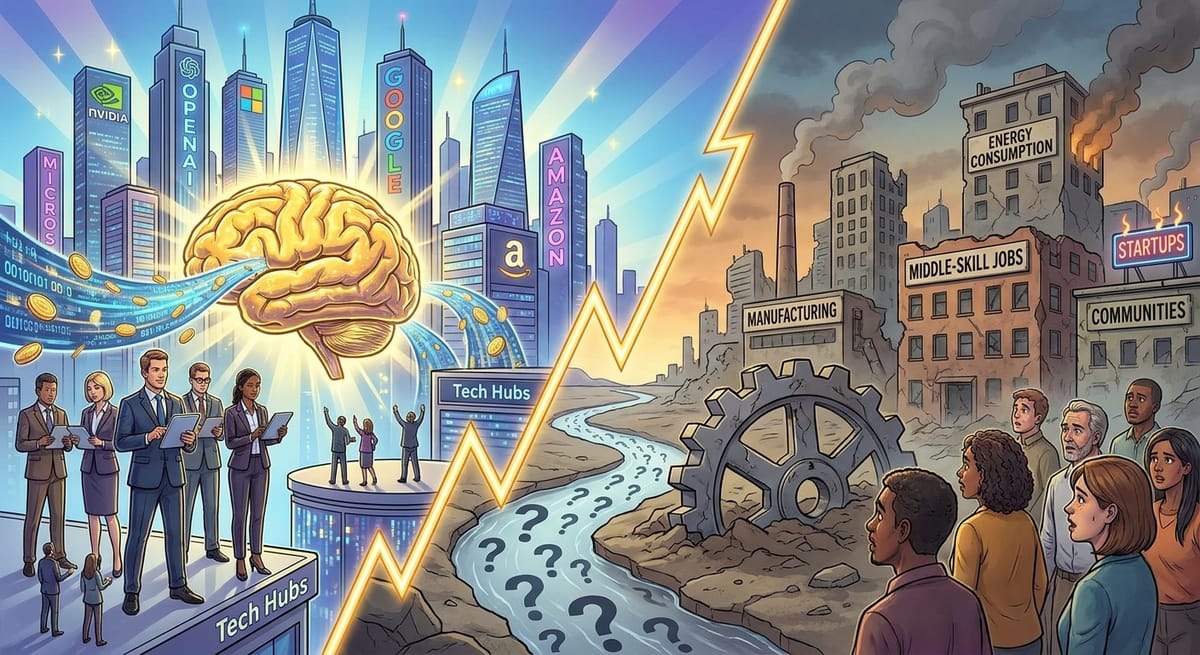
The AI boom has created unprecedented market valuations, but recent volatility raises critical questions: Who truly benefits from AI advancement? Is the economic value being created sustainable, or are we witnessing another tech bubble?
The numbers are staggering. In just a few years, AI-focused companies have seen their valuations skyrocket. NVIDIA, which manufactures the chips that power AI systems, has become one of the most valuable companies in the world. OpenAI, despite being a relatively young company, commands a valuation in the hundreds of billions. Microsoft, Google, and Amazon have each invested tens of billions into AI development.
But look beneath the surface, and a more complex picture emerges. Much of this value is concentrated in a handful of companies—primarily those that control the foundational infrastructure of AI: the chips, the cloud platforms, and the large language models. The promised democratization of AI technology has, so far, largely benefited those who were already at the top of the tech hierarchy.
For workers, the AI revolution presents both opportunities and existential threats. Some jobs will be enhanced by AI tools, making workers more productive. Others will be automated entirely. A McKinsey report estimates that up to 30% of work hours in the US could be automated by 2030. The workers most at risk are often those in middle-skill jobs—exactly the positions that provided stable middle-class employment for previous generations.
The geographic distribution of AI's benefits is equally uneven. Silicon Valley, Seattle, and a few other tech hubs capture the lion's share of AI investment and job creation. Meanwhile, communities that built their economies around manufacturing or other industries face uncertain futures as AI reshapes the economic landscape.
Perhaps most concerning is the energy consumption of AI systems. Training large language models requires enormous amounts of computing power, which translates to significant electricity usage and carbon emissions. As AI systems grow larger and more complex, their environmental footprint grows accordingly. This raises uncomfortable questions about sustainability in an era of climate crisis.
The startup ecosystem around AI has exploded, with thousands of companies claiming to offer AI-powered solutions for everything from healthcare to agriculture. Yet many of these startups are essentially wrappers around existing large language models, adding minimal value while capturing venture capital funding. How many will survive when investors start demanding actual returns?
For consumers, the benefits of AI are real but often overstated. Virtual assistants are more capable than ever, but still frequently frustrating to use. AI-powered recommendations help us find content we enjoy, but also trap us in filter bubbles that limit our exposure to new ideas. The promised productivity gains have yet to show up in macroeconomic statistics.
Looking forward, the key question is not whether AI will create value—it clearly will—but how that value will be distributed. Will AI become a tool for broadly shared prosperity, or will it accelerate the concentration of wealth and power among a technological elite? The answer depends largely on policy choices we make today.
The AI revolution is real, but so are its risks and inequities. Navigating this transition successfully will require clear-eyed analysis of who wins, who loses, and what we can do to shape outcomes for the better.